
1. Category: The Essence of Computation
1. Category: The Essence of Computation
Notes
Categories consist of objects and morphisms between those objects. Morphisms between objects can be composed:
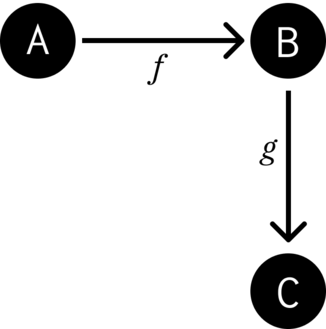
Implies the composition of \(g \circ f\):
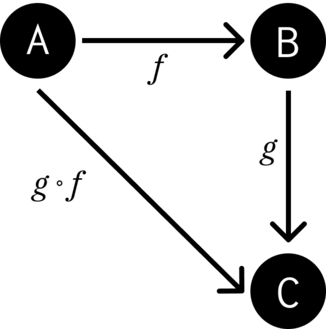
If we think of objects as types and morphisms as functions between those types:
f :: A -> B
g :: B -> C
Then composition would be feeding the result of evaluating f into g. In
Python, it would look something like g(f(x)). In Haskell, one can use g . f.
Composition of morphisms should be associative, meaning that:
Objects also have an identity morphism:
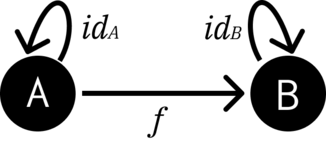
The identity morphism implies that \(f \circ id_{A} = f\) and \(id_{B} \circ f = f\).
1.4 :: Challenges
1.4.1
Implement the identity function in your favourite language (that isn’t Haskell).
def id(a):
    return a
1.4.2
Implement the composition function in your favourite language (takes 2 functions as arguments and returns their composition).
def compose(f, g):
    return lambda x: g(f(x))
1.4.3
Write a program that tests your composition function respects identity.
f = lambda x: x * x
assert compose(f, id)(9) == f(9)
assert compose(id, f)(9) == f(9)
1.4.4
Is the world wide web a category in any sense? Are links morphisms?
Yes. If there is a link from page A to page B, and a link from page B to page C, then the morphisms are composable as there is a hyperlink chain from A to C.
1.4.5
Is Facebook a category, with people as objects and friendships as morphisms
I don’t think so. Person A and Person B being friends, and Person B and Person C being friends does not imply that Person A and Person C are friends. Friendships are not composable, so Facebook is not a category.
1.4.6
When is a directed graph a category?
When, assuming the nodes are objects and edges are morphisms, every node has an edge that resolves at itself (the identity morphism). An edge from node A to node B (A -> B), and an edge from node B to node C (B -> C), implies a traversable path of A -> B -> C, which is essentially a composed morphism of A -> C. I think.