
7. Functors
7. Functors
Notes
A functor is a mapping between categories. Give an category \(C\) with an object \(a\) and a category \(D\), the functor \(F\) will map the object \(a\) to \(Fa\) in category \(D\).
This mapping applies to morphisms too:
A functor, therefore, looks like:
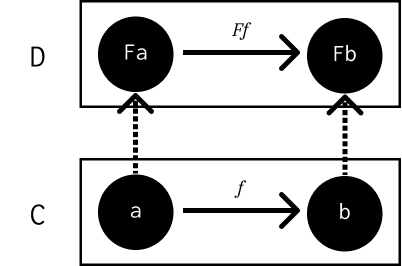
A functor preserves the structure of a category. This also applies to composition:
As well as identity morphisms:
A functor from a singleton category to any other just selects a single object in that category. The constant functor \({\Delta}_c\) maps every object in the source category to 1 selected object \(c\) in the target. It also maps every morphism in the source category to the identity morphism \(id_c\).
An endofunctor is a functor that maps a category to itself, such as types to types.
Functions between categories compose, just as morphisms between objects compose. Functor composition is associative, and every category has a trivial identity functor that maps every object and morphism it itself.
Functors have the same properties as morphisms in the category of categories. The category of categories, like the set of all sets, would have to contain itself and thus be paradoxical. However, there is a category of small categories called Cat. Cat is big, so it cannot be a member of itself. A small category is one whose objects form a set and nothing larger than a set, even if that set is uncountably infinite.
Challenges
7.1
Can we turn the Maybe type constructor into a functor by defining:
fmap _ _ = Nothing
which ignores both of its arguments?
First, lets prove the preservation of identity with the first case, Nothing:
  fmap id Nothing
= { definition of fmap }
  Nothing
= { definition of id }
  id Nothing
So the preservation of identity with Nothing holds. However, when we
consider the second case:
  fmap id (Just x)
= { definition of fmap }
  Nothing
= { definition of id }
  id Nothing
If the preservation of identity held, then we would expect the last substitution
to be id (Just x). This means we cannot turn Maybe into a functor with
that definition of fmap.
7.2
Prove functor laws for the reader functor.
The reader functor is defined as:
instance Functor ((->) r) where
   fmap f g = f . g
For clarity’s sake, the type signature for this application of fmap would
be fmap :: (a -> b) -> (r -> a) -> (r -> b). First, lets prove the
identity law:
  fmap id g
= { definition of fmap }
  id . g
= { definition of id }
  g
= { definition of id }
  id g
Next, the composition preservation law fmap (g . f) = fmap g . fmap f:
  fmap (g . f) h
= { definition of fmap (with some associativity sprinkled in }
   g . f . h
= { definition of fmap }
  g . (fmap f h)
= { definition of fmap }
  fmap g (fmap f h)
= { definition of composition }
  (fmap g . fmap f) h
7.3
Implement the reader functor in your favourite, non-Haskell language.
from functools import partial
from typing import Generic, TypeVar, Callable, Any

r, a, b = TypeVar("r"), TypeVar("a"), TypeVar("b")

class Reader:
    @staticmethod
    def fmap(f: Callable[[a], b], g: Callable[[r], a]) -> Callable[[r], b]:
        return lambda x: f(g(x))


def id(x: Any) -> Any:
    return x


def a2b(x: int) -> str:
    return " ".join(["Hello!"] * x)


def r2a(x: int) -> int:
    return x * 2


assert Reader.fmap(id, r2a)(2) == r2a(2)
assert Reader.fmap(a2b, r2a)(2) == "Hello! Hello! Hello! Hello!"
(I think.)