
8. Functoriality
8. Functoriality
Notes
A bifunctor is a functor of two arguments that maps every pair of objects, one from \(C\) and one from \(D\), to an object in E.
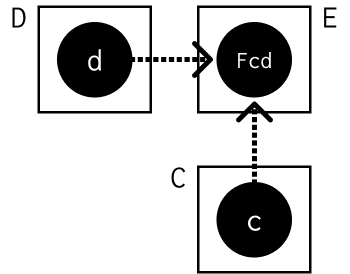
This is just a mapping of a cartesian product \(C \times D \rightarrow E\).
However, bifunctors must map morphisms too. Morphisms in a cartesian product of categories are pairs of morphisms, \((f, g)\). We can compose these pairs:
This composition is also associative and has an identity \((id, id)\). Categories where join functorality fails are premonoidal.
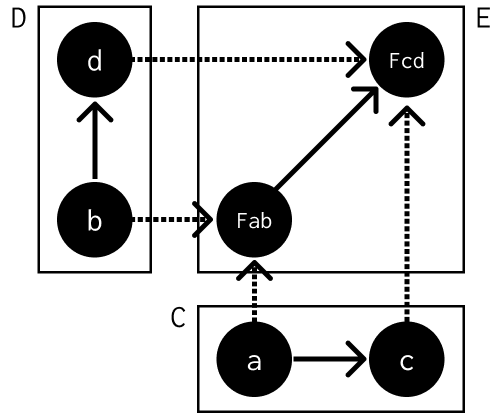
Products and coproducts, if they’re defined for every pair of objects in a
category, are bifunctors. In Haskell, pairs (a, b) and Either a b are
both instances of Bifunctor.
One of the requirements for a monoidal category is that the binary operator associated with it is a bifunctor.
Sum and product types are functorial, as bifunctors. The basic building blocks
of algebraic data types are too: the Const () functor (like Nothing in
Maybe) and the Identity functor (like Just a in Maybe).
Everything else in algebraic data structures is composed from those 2 primitives
using products and sums.
With this in mind, we can define the Maybe up to isomorphism as a composition
of the bifunctor Either with the 2 functors Const () and Identity:
data Maybe a = Either (Const () a) (Identity a)
Consider 3 categories: \(C\), \(C^{op}\) and \(D\), with a functor between \(C^{op}\) and \(D\):
This functor maps \(f^{op} :: a \rightarrow b\) in \(C\) to \(Ff^{op} :: Fa \rightarrow Fb\) in D.
Alongside this, we can define a mapping \(G\), which is not a functor, from \(C\) to \(D\). It maps objects, but reverses the morphisms it maps. It takes \(f :: b \rightarrow a\) in \(C\), maps it to its opposite in \(C^{op} f^{op} :: a \rightarrow b\), and then uses the functor \(F\) to get \(Ff^{op} :: Fa \rightarrow Fb\).
Since \(Fa\) and \(Ga\) are the same, this can be described as:
A mapping of categories that inverts the morphism direction like this is a contravariant functor.
Regular functors are covariant functors. A contravariant functor is a covariant functor from the opposite category.
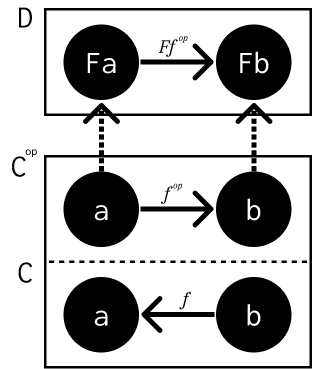
(->) is contravariant in its first argument and covariant in the second.
If the target category is Set, this is a profunctor. Contravariant
functors are equivalent to covariant functors in the opposite set, so a
profunctor is defined as:
And looks like:
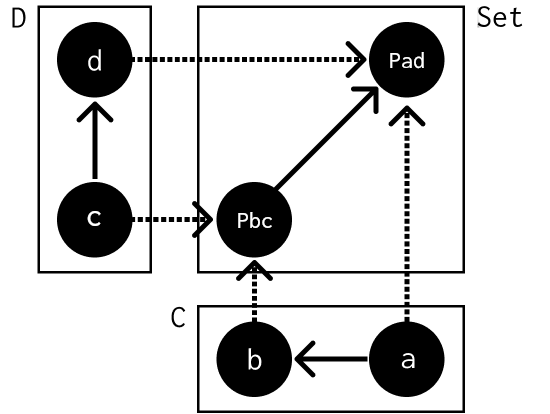
The mapping that takes a pair of objects \((a, b)\) and assigns the pair to the set of morphisms between them, \(Hom_{C}(a, b)\), is a functor from \(C^{op} \times C \rightarrow Set\).
Challenges
8.1
Show that the data type:
data Pair a b = Pair a b
is a bifunctor. For additional credit implement all three methods of Bifunctor and use equational reasoning to show that these definitions are compatible with the default implementations whenever they can be applied.
We can turn Pair into a functor by fixing the first argument type:
instance Functor (Pair a) where
   fmap f (Pair a b) = Pair a (f b)
We can prove this preserves identity through equational reasoning like in the last chapter:
  fmap id (Pair a b)
= { def of fmap }
  Pair a (id b)
= { def of id }
  Pair a b
= { def of id }
  id (Pair a b)
Next, the composition preservation law:
  fmap (g . f) (Pair a b)
= { def of fmap }
  Pair a (g(f b))
= { def of fmap }
  fmap g (Pair a (f b))
= { def of fmap }
  fmap g (fmap f (Pair a b))
= { composition }
  (fmap g . fmap f) (Pair a b)
So, Pair acts as a functor in the second argument type. We can also implement
Pair as a functor by fixing the b type of Pair a b, implementing
fmap as fmap f (Pair a b) = Pair (f a) b and proving the identity and
composition laws the same way.
Implemented as a Bifunctor:
instance Bifunctor Pair where
   bimap f g (Pair a b) = Pair (f a) (g b)
   first f (Pair a b)   = Pair (f a) b
   second g (Pair a b)  = Pair a (f b)
8.2
Show the isomorphism between the standard definition of Maybe and this desugaring:
type Maybe' a = Either (Const () a) (Identity a)
By defining two mappings between the two implementations.
The default implementation of Maybe is:
type Maybe a = Nothing | Just a
And we can define the mappings between the two types as:
import Data.Functor.Const
import Data.Functor.Identity

type Maybe' a = Either (Const () a) (Identity a)

a2b :: Maybe a -> Maybe' a
a2b Nothing = Left (Const ())
a2b (Just x) = Right (Identity x)

b2a :: Maybe' a -> Maybe a
b2a (Left (Const ())) = Nothing
b2a (Right (Identity x)) = Just x